Wednesday, September 24, 2014

Dissecting The Un-Makerspace: Recycled Learning


A 1980's cassette player, a broken computer mouse, an old monitor... all ready for the dumpster... drop it by my classroom! Why? For my "Un-Maker Space" inspired by my first journey to the Bay Area Maker Faire two years ago. This Steampunk Mad-Scientists event with its many innovation, creative geniuses and 100,000’s of onlookers descending on the San Mateo, California area with such a wide array of inventions, it would be hard not to be inspired!
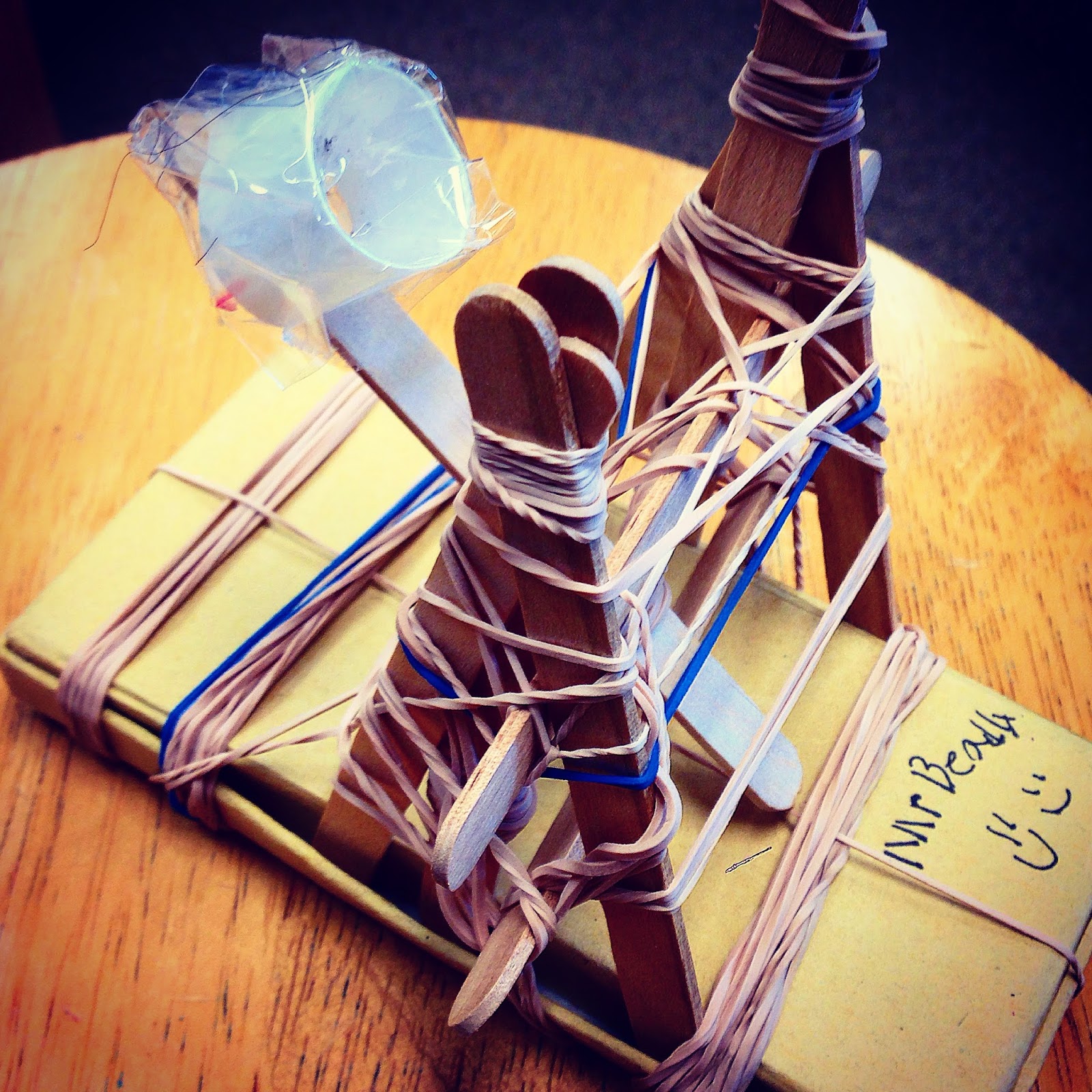
IMG_2510.JPGLet's step back for a moment.  I love all the recent focus on Maker Spaces in schools. If you’re not familiar with what a Maker Space is check out this blog by Vicki Davis. Basically a Maker Space is a place for students to take raw materials and create “things” using their imagination. The creativity required and the "in-time" learning that a maker space provides is powerful. I saw an example of the power of "making" this last school year when I had students, who would normally struggle in a traditional class, create things such as a working catapult fashioned out of popsicle sticks, rubber-bands and cardboard.
IMG_3494.JPG
My journey into exploring the power of making continues for a 3rd year with two added goals. First,I plan to expand the depth of learning that goes with "making" by creating Maker Connection Logs where students write, take photos, and record short videos to show their thinking while making connections between curriculum areas and their creations. The goal of the “Maker Logs” is for students to be able to give me insight into their creative process, thinking and provide a way for reflecting with the hopes of improving the future process of "making."

IMG_3496.JPG
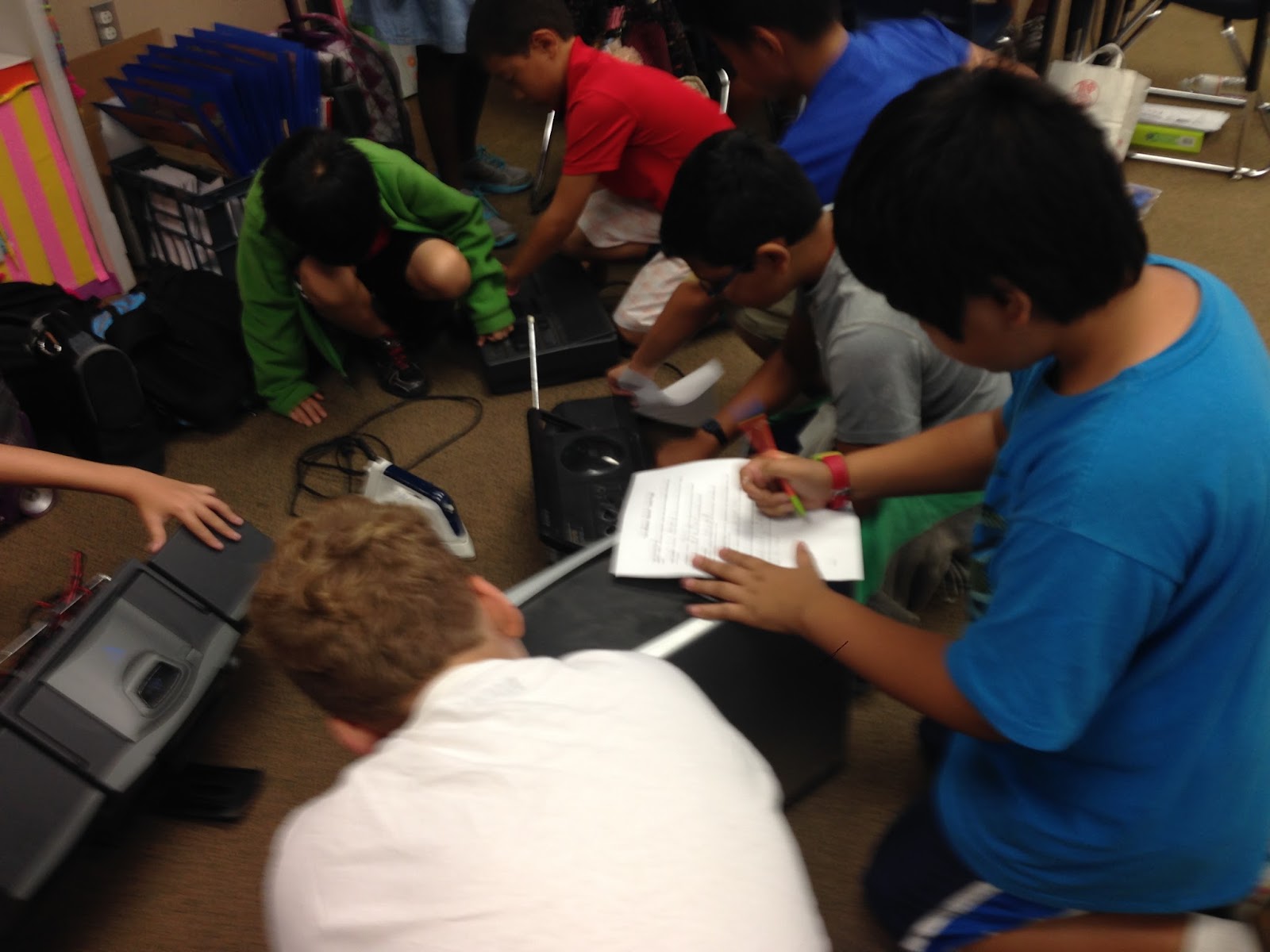
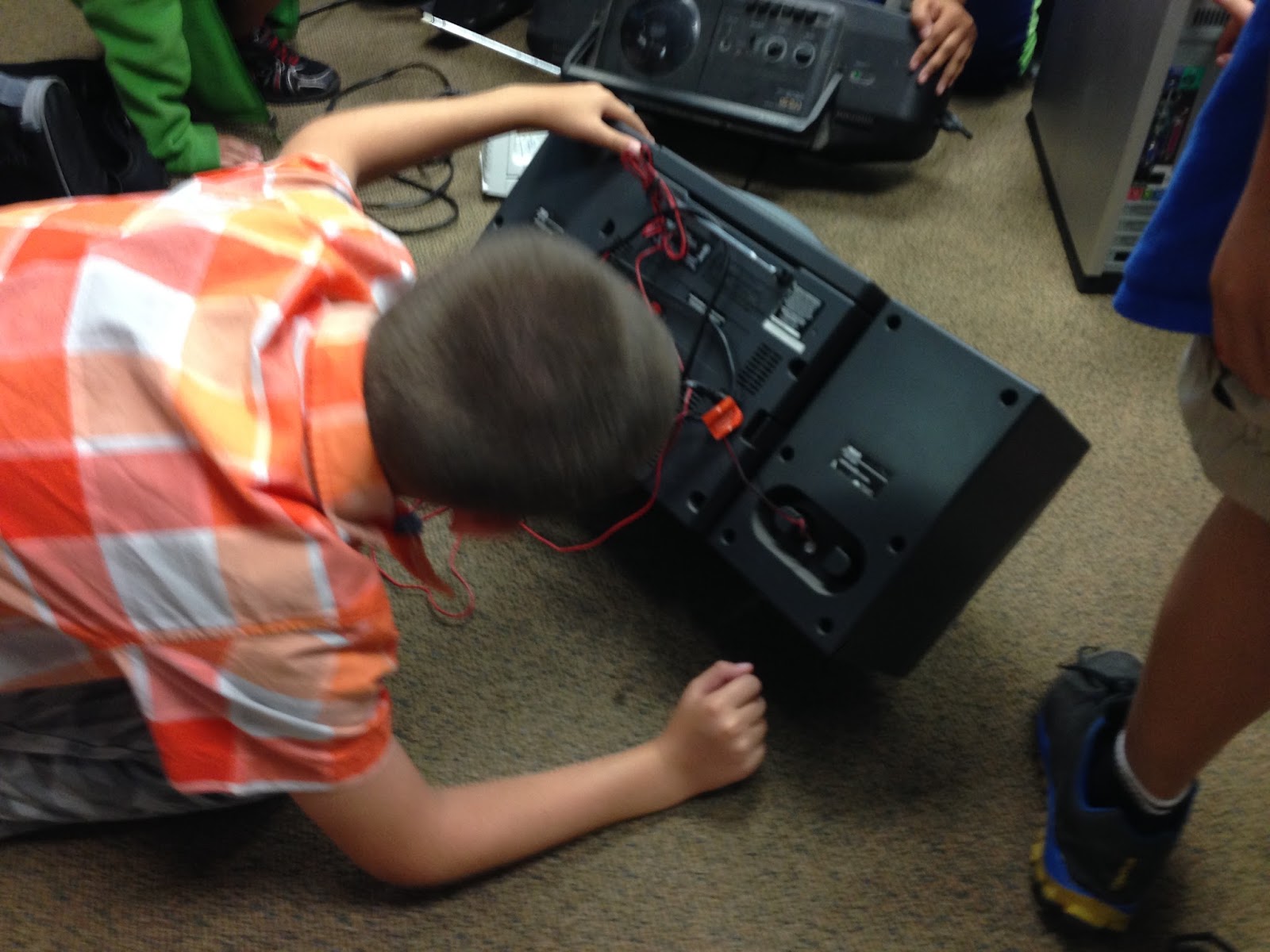
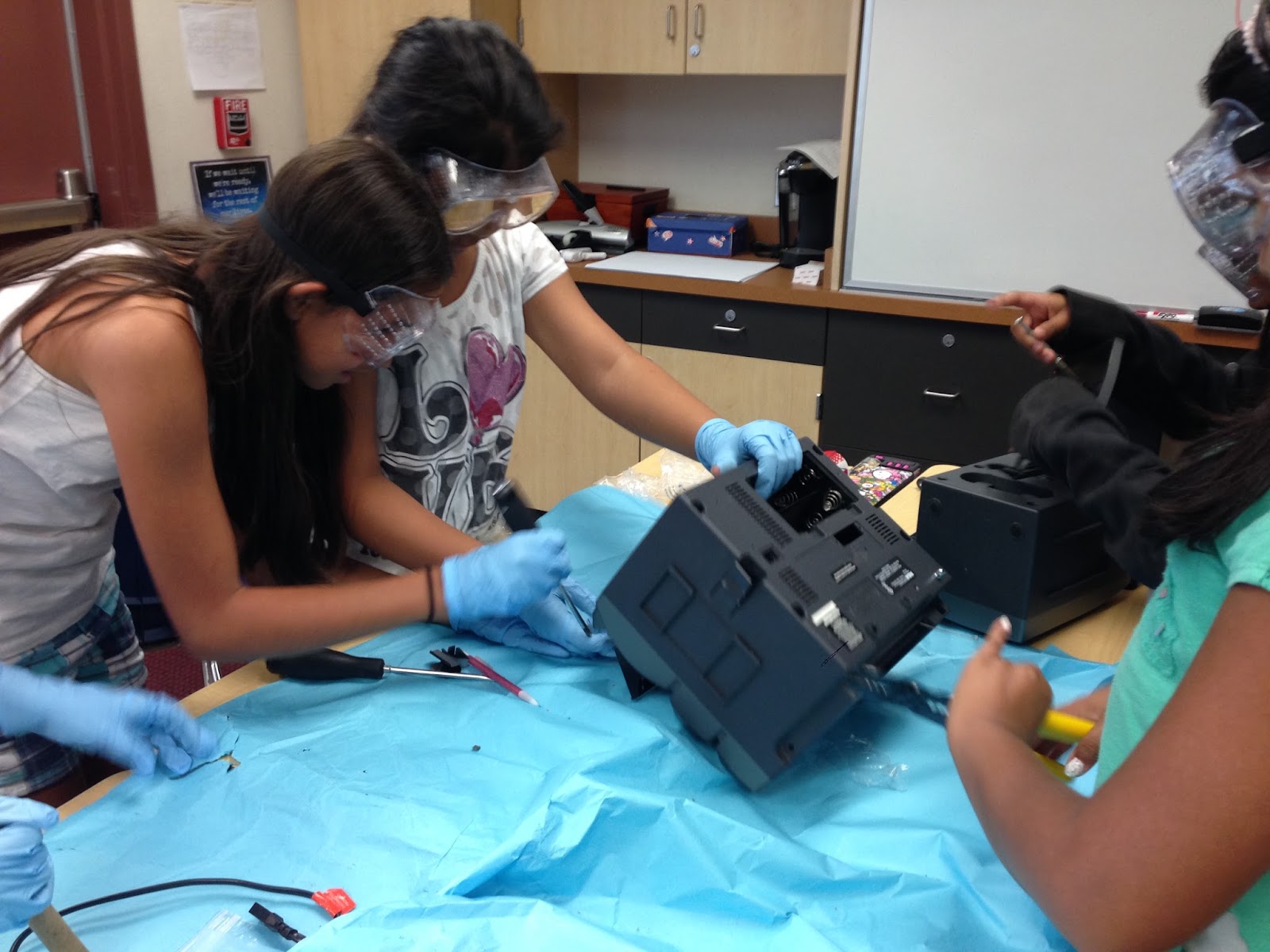
My second goal, which I recently accomplished, is to create an "Un-Maker Space." Simply put, a space where kids can take things apart.  So many of the creative geniuses I met at the Bay Area Maker Faire two years ago spoke of taking things apart when they were kids. Watching my 3 year old son recently take apart his toy vacuum really solidified this idea for me. We all have this inner drive to create an understanding of the world around us. This is founded in the desire to answer all the "why" and "how" questions in our thoughts. Why did that little wheel spin when I pushed the play button on that cassette player? How did the electricity get from the cord into the monitor and then create a picture? How can I take this apart?  So my students will have a space to dissect all the discarded and unwanted items and to ask those questions. In this un-maker space they’ll have the chance to explore the possible answers.

IMG_3557.JPG
How will I do this? Garage sales! Tool donations, safety gear... And a means for them to log their dissections through writing, photos and video as we explore the scientific way to take things apart.  I see many opportunities for learning including opportunities in math, writing, critical thinking, fine motor skills, and a chance to help develop a greater level of executive functioning skills (to name just a few).  I work hard to foster an atmosphere where student questions drive their desire to learn and this fits right in with it.

Beyond all the learning taking place in the dissection process, it will provide opportunities for students to try and rebuild or use the parts to create something new.
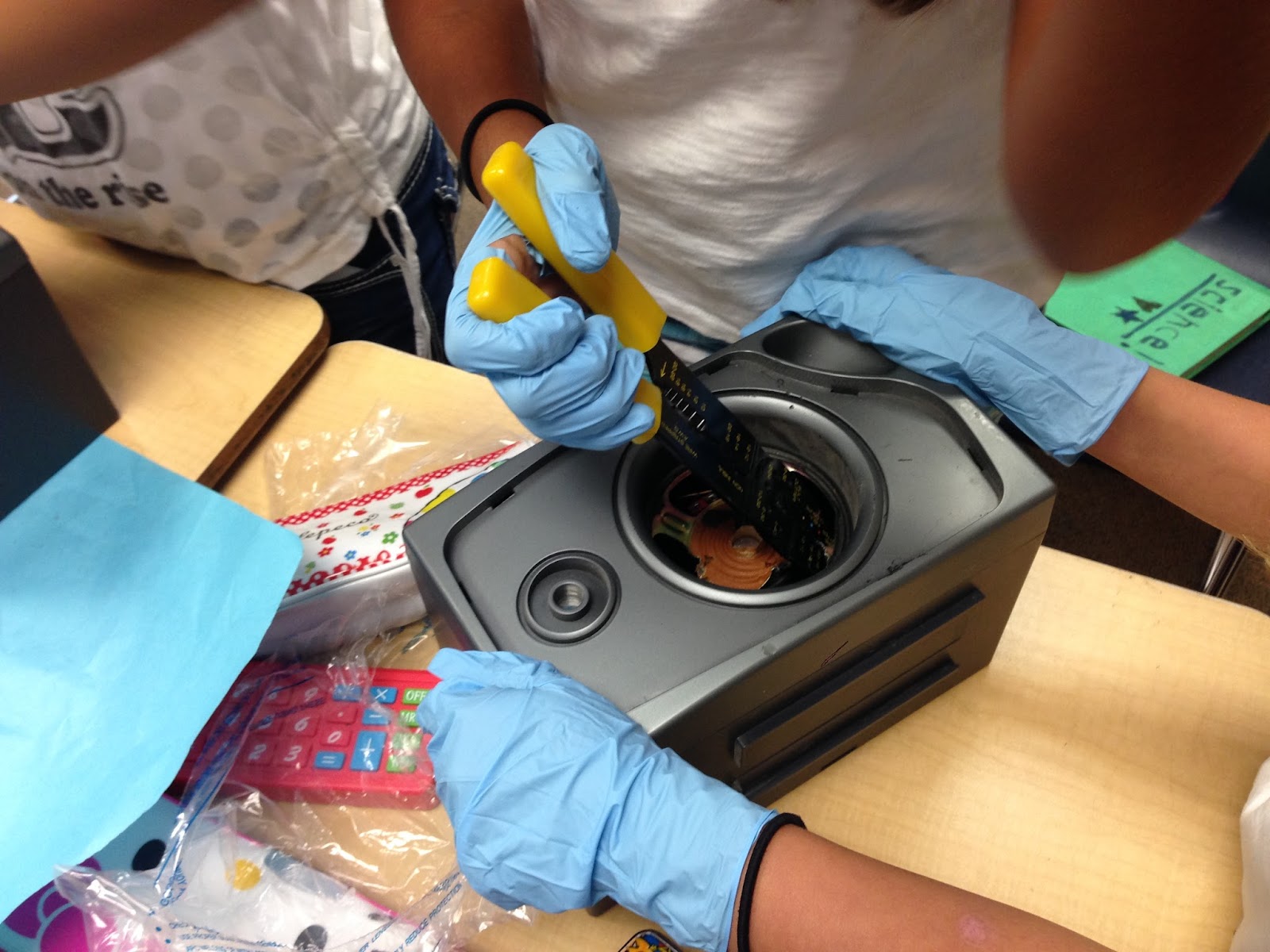

IMG_3576.JPGSo join me and grab those broken cassette tape players before they get tossed into the dumpster. Smile when you see a keyboard that isn't working, and celebrate that old laptop with the broken screen that is out of warranty. It's all how we look at things, our mindset, that can lead us to finding "new" in the old, new questions to answer, new places to explore and new learning to gain. As for those broken "unusables," they get a second life by becoming another learning opportunity for our students! When will you have an UnMaker event in your classroom or at your site?  


I'd love to hear your thoughts. I would also be happy to share the guiding document I created to use with my "Un-Maker" teams.


Monday, July 7, 2014

Assigning Optional Homework?

So... Should homework be required or eliminated?

A few years back, my district went through an exercise of looking at homework and our policies surrounding it.  Meetings were had, discussions and debates occurred, and in the end... nothing much seemed to have changed.  I understand why... this is a tough issue! Homework, after all, is truly a pillar of education.  So as the debate over homework seems to continue on like Pink Floyd's song "Comfortably Numb" ...looped..., some arguing for it and others against it, all with no solution... I'd like to propose an optional new policy... The Optional Homework Policy.  The optional homework policy states this... "Students, if you or your parents would like you to complete homework, then here are your options."  Yes, giving the decision making power, to have or not have homework, over to the students and their families. Crazy!?  Will Not Work!  Kids' Scores Will Drop!  Before you judge, please think growth mindset... and know that I've actually been testing this out over the past school year with positive results for all parties involved with the homework debate.

There are three basic explanations/reasons why I reconsidered required or no homework:

Grades, Grades, Grades...

As teachers we have the choice to calculate homework into a grade or not.  Most teachers I know have homework as a small percentage of a student's overall performance, yet many of the report card conversations between teachers, parents and students, from my experience and as shared with by many other teachers, revolve around the topic of missing or late homework.  Now I don't believe that something should be changed to avoid a conversation, but these conversations can often become distractors or points of contention between parent and student, student and teacher, and teacher and parent, thus creating problems in partnerships that are vital to real learning. These homework conversations are another draw away from the important conversation about learning, true student needs, and areas of growth.

The important question to ask oneself about homework grades is why is it being given?  The typical answer would be work completion, practice of concepts or responsibility at primary levels, and preparation at the higher levels.  Most don't say that the primary or important factor in homework is as a diagnostic tool to report to parents on a students ability or performance. There's too many variables that impact homework to use it as a diagnostic for student learning or as a tool to help guide future lessons and instruction. When homework becomes optional though, the feedback, and not the grade, become more important to the learner.  Feedback is how we learn.  I've seen the focus shift and become about the quality rather than the completion. So rather than giving grades based on completion of work, grades can continue to move towards being about reporting levels of learning growth.

Help or lack of it

It's a "Goldie Locks" deal... some get too much, some not enough and others just the right amount. While parents and teachers are often on one side or the other in this debate, the optional homework policy pleases all. Ideally the parents who may offer too much help to a child, thus taking away their chance to feel the success that builds confidence, find that their help (which is at times aimed at grades) becomes obsolete and the focus shifts to supporting a child's learning.  Fewer conflicts occur between child and parent and student and teacher.  On the other hand, the student that always struggles with homework, and comes to our learning environments already with a feeling of failure, now is far more open to learning.


Real Impact?

On a study my teaching partners and I did in 2007, surrounding homework's true impact, we found that through a comparison based in data, the students who received less homework (in the subject area of math for our study) had three key factors surface.  First, parents reported better relationships with these children. Next, students positive attitudes and feelings towards learning and school showed a measurable increase as well as in-class focus and participation based on surveys and observable evidence by two outside teachers watching the three groups in class for engagement and effort. Finally, the group who received the least amount of homework, actually showed the highest percentage of gains from pre-assessment to post assessment on the math concepts.  Again, with the number of variables, I can't say beyond doubt that homework or lack of it, was the factor that truly made the difference, but it did play a key factor.


Still not convinced... Me either

My main hope is to "get you up on the fence" about this topic so you can look down on both sides and clearly evaluate homework requirement practices and why they are in place.  One quote that sticks with me came from some of the additional video content from the movie Race to Nowhere.

"Homework may be the greatest single extinguisher of children's curiosity that we have yet invented..."

So, where do our fears as educators and in education lie with letting go of homework? Are we giving homework because it's always been done or because it makes a positive impact?  If you believe it makes a positive impact, what real concrete proof do you have that it's the homework providing this improvement?

I write this blog only to encourage you to question things that have always been... I hope you'll question some norms... maybe even check out my previous post titled "Subversive Education Unconference Style"

My Steps and Results

So what did I do to make homework optional? Well... when I change things I don't only consider the implementation I will make, but I consider "will others be able to do this too?"  Confession... This isn't for everyone. Baiscally I took the assignments I would normally assign and said... "This is optional..."  after all, I have no foundational research to show homework was actually beneficial, so how could I justify continuing a required practice that no one could prove even worked after decades and decades of research and debate.  So rather than stop giving it, or continuing to require it... I made it optional leaving the decision to the parents and students.

How has my experiment gone? First, please know I wouldn't have tested this without the data from the study we did in 2007 and a great deal of research... but it's been great!  One of the most positive outcomes I've seen is that it's pushed me as an educator to continue create in-class assignments that drive kids to want to continue their learning on their own at home, intrinsically, by choice. It's so rewarding to have my students have the desire to learn more about a subject I'm teaching, because it's one of the main reasons I went into teaching... to inspire my students to learn.  In addition, many students who have wilted under "required homework" policies have started to blossom and come to life as learners in my subject areas.  I can't say beyond a doubt that The Optional Homework Policy has alone created the success and desire to learn I've seen, as I'm always trying new ways to inspire my students to learn, but I do feel confident it's been a key contributing factor to success for both my students and myself.

I'd love to hear your thoughts on the issue.

Are you going to try The Optional Homework Policy? Tweet at me or comment to let me know.  My next action step... student choice self-assigned homework. I'll let you know how it goes...

Additional reading on the homework debate that's gone on since the early 1900's ACSD's look at Homework through the 20th and 21st Centuries

Thanks so much for reading!  With my best hopes for you and your students!

Subscribe and check out my next blog post on Creating E-Magazines with your students or read my recent post on Live Broadcasting: Creating Your Own Student Press Conferences!