Friday, February 3, 2017

Play Needs a Rebrand... #GSPD

Play is not frivolous or only to be given as a reward. It's vital.

 It's hard to believe we just celebrated three years of Global School Play Day. This small idea born from Dr Peter Gray's Tedx talk and from the frustration of hearing about districts across the nation cancelling recess in the name of more test prep, has truly become a global movement. I remember Tim (my brother/a co-founder) and I talking about the hopes that in year one, GSPD's small leadership group (Eric, Oliver, Bethany, Misty, Tim and myself), could get the teachers of 10,000 students to agree with us that unstructured play was and is vital to a child's healthy development. It went beyond just asking them to support it, we were asking them to also back that belief with action that went against the current trend of hours of homework, test prep and the massive decline in the amount of unstructured play time for kids. Think about it...even play has become another scheduled event in a child's busy life, "play dates." 


    In 2015, we were blown away, that after a little more then one month of sharing on social media, teachers representing over 66,000 students had agreed to let their kids have unstructured play time on the first Wednesday in February. Even Brown University joined in that year.
One of the many tweets encouraging participation in #GSPD2016
  Despite the success that a small team of dedicated educators saw in year one, we were unsure what 2016 would hold for Global School Play Day. By GSPD 2016, there were more than 177,000 students playing in just the second year. It was incredible!
I'll never forget checking twitter on what was the night before GSPD 2016 for my class. I saw that it had really kicked off in South Korea and New Zealand with some great pictures and video of the fun being posted. A tweet came across the hashtag (#GSPD2016) with a video of some students at a school in New Zealand who had set up a plastic "slip and slide" at their school. A line of kids waited for their turn. When I saw that, I got goose bumps realizing the impact this movement could have for kids around the world. Each part of the day, each hour, each minute, each second more of these amazing moments of joy-filled play were shared. When the day ended, we already had signups for the next GSPD.

Last summer, I found myself questioning if we could pull this off for a third straight year. I was exhausted and facing some heartbreaking family health issues as we lead up to GSPD 2017. 

Twitter post from just a few days before #GSPD2017
  Well, #GSPD2017 just happened on February 1st. On that day, that beautiful day we call Global School Play Day 2017, over 280,000 kids from more than 50 nations, on 6 continents had been registered to play, and play they did. You can scroll through any of the hashtags from the last three years of GSPD to see tens of thousands of videos and images. In those images, you'll see is the true joy that this day allows for in each and every child who is given this gift from the caring educator who has made the decision to celebrate unstructured play. The amazing impact is not only for the kids, but you'll see it on the faces of the educators who took the risk giving up one day of traditional instruction and gave themselves the chance to see the power of play. 

   I've heard from many educators that this day has been a true revival for their spirit and passion and a renewal of the joy that their students can bring them. So many have said that the loss of play in the school day has been a gradual decline as the system has turned their vision of education towards testing, accountability and data all while shifting their focus away from joy of teaching, the love of learning and the passion for their positive impact.  While I don't want to overstate the impact of Global School Play Day, I have to believe that if every educator were to experience it, they would become a believer again in unstructured play and shift what they do every day in class. They would shift the demands they place on kids outside of the school day. They would shift their vision back to their first passion of impacting children's lives rather than feeling pushed into the single focus of delivering content to score high on a single high-stakes assessment. I found myself caught up in that mindset, but because of questioning why we had moved so far away from the needs of children and because of the educators around me who are constantly challenging the "why?" , I find myself free. Free to make my classroom student centered not content centered; free to love my students where they are in their learning journey; free to empower them as learners; and free to let them discover life on their own. 

Photo Credit to Eric Saibel
I want to challenge you, if you've yet to test out unstructured play in your own classroom. Try it. In the 180 plus school days, what harm could one day of play do compared to the massive benefits you will open up for your students. As always, thank you for reading this post and I value your comments. I know it's been a while since my last post, but I was driven by my passion for this movement to share my thoughts through writing.
  

Global School Play Day Info


What If the World Came Together Around Play? It did in February. More than 275,000 children, from 51 Nations, on 6 continents were given the gift of unstructured play! How many will play in 2018?


  1. Argentina,
  2. Angola,
  3. Australia,
  4. Austria,
  5. The Bahamas,
  6. Kingdom of Bahrain,
  7. Belarus,
  8. Belgium,
  9. Brazil,
  10. Canada,  
  11. Cambodia,
  12. Czech Republic,
  13. Dominican Republic,
  14. Egypt,
  15. England(UK),
  16. Ethiopia,
  17. France,
  18. Georgia,
  19. Germany,
  20. Ghana,
  21. Greece,
  22. Guatemala,
  23. India,
  24. Indonesia,
  25. Iraq,
  26. Japan,  
  27. Lithuania,
  28. Luxembourg,
  29. Malaysia,
  30. Montenegro,
  31. New Zealand,
  32. Nigeria,
  33. Pakistan,
  34. Philippines,
  35. Poland,
  36. Portugal,
  37. România,
  38. Russia,
  39. Saudi Arabia,
  40. Scotland (UK),
  41. Singapore,
  42. South Africa,
  43. South Korea,
  44. Spain,
  45. Switzerland,
  46. Thailand,
  47. Turkey,
  48. United Arab EmIrates,
  49. Ukraine,
  50. United States,
  51. Viet Nam

 Thanks to Greg Smith for his thoughts on play and title of this blog. He shared this idea of play needed a rebrand at Edcamp LA a few years ago and it's stuck with me ever since. I think it was and still is, yet another brilliant insight from Greg.

Sunday, July 26, 2015

Solving the Grand Challenges in Education... My Annual Reading Assignment Focused on #EduIcons and Progress

What do you believe are the "Grand Challenges" in Education?

The target moves, we shoot. It moves again. We shoot again. It feels like this continually moving target, that we all get caught up in trying to hit, and may likely never be hit. So let's stop shooting at others' targets and start defining our own. When you think of what you want your students to leave your class with, are there keys? Do we even know the right questions to define our targets?

What questions do you believe we need to help set up our targets for success? I'll be adding three books to my reading list specifically focused on expanding my perspective over the next year in an effort to dive deep into thinking about the targets that will help the way I teach. One is Alfie Kohn's School Beyond Measure. I've always admired Alfie Kohn's contrarian look at things and agree with him on some (but not all) perspectives. Another book from one of the people I consider an "Education Icon" (#EduIcon) is John Seely Brown's The Power of Pull: How Small Moves, Smartly Made, Can Set Big Things in Motion. I love the concept of "small moves" that can lead to bigger change. Next on my list of reading is another #EduIcon, Dr. Howard Gardner. His book The Unschooled Mind, a book that's been out there for some time but seems to have slipped past me until now, is focused on merging cognitive science with the education agenda.

I'm looking forward to continuing to challenge myself to rethink what type of education I'm providing for my students. I do this because I want every teacher my son has to do the same. Join me in reading. I'd love to hear your thoughts on any of these books.

Thanks for visiting the blog and I hope you'll consider following me as I share more over this next year.  You may also want to check out the Bedley Brothers Edchat Podcast where we highlight many of the leaders in the world of education.


Optional Reading: I just finished Ron Clark's new book Move Your Bus and was hoping the book would help me better define my targets or help to identify questions to improve education and learning. An interesting book (Please don't get mad Ron Clark followers), but I found it a bit disappointing for a title that says it is "An Extraordinary" insight at "Accelerating Success." Ok Amanda Ripley... I hope your book The Smartest Kids in the World lives up to the hype because you're up next.

Saturday, May 2, 2015

5 Things We Have To Stop Pretending

Well it happened. I was challenged to give my list of 5 things we have to stop pretending in education by an amazing educator Jeanne Reed (@jeannereed1 on the Twitters). 

As I’ve read other posts on this blog post challenge topic, it’s been interesting to get an insight into the thinking of connected educators nationwide.  I would love to see how this topic would turn out if it was posed at every staff meeting at the end of the school year and... at the beginning of the school year. The reason I’d like those contrasting times, is the emotions are far different.  Getting the pulse of connected educators, at this time of the school year, while being entrenched in massively expensive (financial and work hours) standardized tests, open house events, and even closing out the year can be filled with higher levels of stress and anxiety. Here are the 5 I selected from my thoughts.


5 Things We Have to Stop Pretending:


  • that the “Keeping Up with the Joneses” mentality doesn’t happen in education.
  • that educational time spent on strengthening weakness is more important than time spent on identifying and enhancing strengths and talents (of children and educators).
  • that there are not deep divides in the "education world" on the topic of “Best Ways to Educate Children.”
  • that standardization is the way to improve education and that most educators like it.
  • that we can close the “Achievement Gap” without closing the “Opportunity Gap” (AKA - poverty - Read my upcoming post on Closing the Opportunity Gap).


Note: I didn’t number these opinions because to me no one is more important than another. They each carry weight. I hope, we as a connected education community, can work to resolve these things but allow for a diversity of solutions without being overly critical of efforts to provide the best possible education we can imagine for our children.


I’d like to invite about 100 people to join in this... but to follow the pattern I select Genein Letford, Oliver Schinkten, Timothy Bedley, Jon Samuelson and Christina Luce to share their thoughts. I have a tremendous amount of respect for each of these friends and educators because of the fact that they are action based.

Optional Reading… My other opinions on this topic that we have to stop pretending: That Standards Are Focusing on developing Critical Thinkers Vs Consumers; That We Aren’t Thinking to Highly of Tech Tools as Solutions; That Strategies and Pedagogy Are the Means to Improvement in In-Class Teaching (relationship is to me); That Kids Don’t Like Mindless Worksheets sometimes; That More Work/Assignments/Projects Get’s Better Learning Results; That Education’s Bottom Line is Student Learning and Not Money; That the Correct Policy or Set Of Standards Will Make Education Better; That Assigning Reading At Home (Reading Logs) Means All Kids Are Really Reading At Home; That Homework is Actually an Effective Means to Improve Student Performance.

Share your thoughts on this topic even if I didn't challenge you... We need to keep the conversations going to progress as an education community!

Sunday, April 19, 2015

Giving Back to Philadelphia at ISTE 2015 = #SliceOfISTE

So many times I'm thankful for the learning that goes on at a conference. I enjoy seeing all the amazing people from my PLN and meeting new people to expand my PLN. I love the energy that surrounds learning and education conversations. Often, prior to a conference, we will share about sessions we may be considering, make dinner plans, talk about what we hope to get out of or add to the conference, but for ISTE the conversation shifted to "What is it that we feel we can give to the city and the people of Philadelphia?”


The idea of giving back is nothing original, but it is so extremely valuable. While listening to one of the best young educators Sara Boucher (@MsGeekyTeach) as she shared a story about how one restaurant in Philadelphia that was giving to the homeless, I caught her enthusiasm. She was hoping to get a group of us to visit that pizza place while at ISTE.  Her excitement for the story spawned the start of something that we are hoping expands and catches fire among attendees and those #NotAtISTE alike.


Rosa's Fresh Pizza in Philadelphia has had some recent press coverage including being on the Ellen Show for their efforts to give slices of pizza to the homeless of the local community. The hopes are to have ISTE attendees flood this local business with free slices of pizza which would be used to serve any homeless who may be in need of a meal. As the discussion continued, it blossomed beyond just a small group of friends headed over for a slice, into a planning session for ways we could help the community of Philadelphia in many ways, thanks to Tracy Clark.


So join this simple movement in giving back to the city we have the opportunity to travel to for education conferences. Buy a slice of pizza for a homeless person at Rosa's or find another way to contribute to the local community. Join Tracy Clark, John Stevens, Karl Lindgren-Streicher, Victoria Olson, Sara and I by looking for ways to give as we all travel to Philadelphia. Please share about your plans for giving back by using #SliceOfISTE on Twitter or Instagram.

Not going to ISTE? You can still give or plan similar type activities at the next conference you attend. Thanks for reading. Be sure to follow @SliceOfISTE for updates and info on opportunities to give back during ISTE 2015. Check out some of my other blog posts on education.

Friday, March 27, 2015

Profession Development Gluttony? Refine your Palate.


Are you a professional development glutton? Take the Quiz:

Do you feel like there is nothing in teacher training sessions that you really enjoy?
Do you look over the session schedule and are uninterested in most sessions being offered?
Do you often wonder why so many sessions feel the same?
Do your conversations fall back to "how can we do professional development different?"
Do you feel like your wasting your time at conferences but you still attend?
Have you been to 10 or more trainings in the last year?

Did you answer yes to any or most of these questions?

So are you fat? Not physically... but are you fat with knowledge? Are you part of the growing group of educators who are eating at the ever expanding table of educations professional development?

For a while, it felt as though professional development, at least in California, had all but disappeared. Now it seems as though the opportunities are endless. I find myself feeling like I've been gorging at the PD table for the last few years.  As creatures of habits, I continue to go back to the same style of restaurant all while expecting new flavors that I can't find on the menu. I search the menu of sessions hoping to see something that sounds tasty, but it's all starting to look the same. How many ways can you have "tech-calamari" or "pedagogy-pasta?"  I've been doing my best to share all the food I've been enjoying, but more and more the flavors seem to lose their taste.

Others I know, who are also feeling full as well, are turning like foodies, to try and discover the hole-in-the-wall restaurant that's yet undiscovered. Some who are searching are even becoming their own chiefs by offering PD in ways that may not have been offered. Others are even going as far as opening their own "restaurants" or by starting "PD franchises."  And others are traveling great distances hoping to find different flavors to bring back home. Some have stuck close and are trying to demand more from the same restaurant we've been eating at for years. All these efforts don't seem to get to the heart of the matter.   When you're full your full.  Sometimes stepping away from the table is the best solution.  I'm certainly not trying to imply that anyone should stop going to professional development, but I am challenging the notion that more professional development leads to better classroom learning for students. For me, I need to refine my palate. How do I plan on doing this in the next few years?

My hopes are to put aside professional development and focus on personal development.  I want to find ways to expand the person I am, develop new passions, and learn more about things outside of education than inside. To put into practice, in my own life, all I've learned that is great for my students. I'm going to do more making, playing, and less homework! I'm going to spend more time experiencing learning through projects, choice and inquiry. I'm going to get back to the roots of learning. My hopes are that I'll discover what else I can offer my students and their families. I hope this will refine my palate.

Refining your palate and expanding your taste seems to be the way I will move forward as an educator.  Does your palate need refining? How will you refine yours? Share with me and be sure to check out some of my past blog post, point out errors or just say hello.

Monday, January 19, 2015

If Learning was a Currency, What's Your Tax Bracket?


EdCamp San Diego, Circa 2014


Walking in I was greeted by excitement, enthusiasm, and a clear desire to learn. It’s the feeling I get at the beginning of each EdCamp I’ve attended. The session board fills and you select, which is powerful. Sometimes though it’s the conversation, with other passionate educators, in the hallways that inspires the most progress in my classroom. This time it happened to be in the lounge/lunch area.

Wrapped closely around the circular lunch tables, I sat with Karl Lindgren-Streicher and Laura Spencer looking for a different conversation than any of the second session topics offered. Listening to two such passionate educators sent me a drift in thought. We discussed successful and unsuccessful teaching strategies through the sharing of experiences in our lives. In my head, I kept coming back to the question, how do we assign value to learning as educators? I started to share. Below are the questions that spun in my head from that conversation as well as a few of the ways I answered. I’d would have loved to have you there with us, since that time has past, join the conversation now, how would you answer these questions.


If learning was a currency…

We often avoid a public discussion on the topic of defining quality teaching or we spend a disproportionate amount of time criticizing poor teaching strategies without being able to truly pinpoint what makes a quality educator. The Gates Foundation has spent years and vast amounts of money trying to identify this very thing. Ultimately, the issue falls back to how do we identify what is success. I believe it is the relationships you create and the learning happening in a classroom.

As teachers, I believe we would want to be judged on the relationships we build that lead to learning, but what if learning was a literal currency? Where would each of us find ourselves financially Rich? or Poor? or Middle Class? Would we strive to be part of the wealthy class, or be satisfied with being in the middle class? (Vacations once a year, enough to feel satisfied and that you have it better than most.) Does our current education system have too large of a "middle class?" Have we become comfortable in the amount of "learning currency" we're earning in our lessons and lectures or have we become so far in debt trying to avoid leaving any children behind that we are just trying to survive. Is the learning "wealthy class" expanding at a rapid rate or is it shrinking? Do we have so much learning "currency" we should start donating the extra to others who find themselves in a less fortunate situation? Would our investments in learning "currency" be getting double digit returns or less then 1% interest?  Are we hoarding vast amounts of knowledge on investment strategies that lead to high returns in learning "currency?" Have we stopped taking the time to follow wise investment strategies? What is each of our "learning currency" tax bracket?

There were so many questions that played out in my head with regards to imagining learning as a currency, questions that eventually ended up in the conversations we had at that table. It's a thought I couldn't leave behind at EdCampSD. I'll leave you with this thought to hopefully inspire your reflection in this area. Since learning isn't a limited resource, why can't we continue to expand the "wealthy class" and shrink the "middle class" down to nothing. I really believe reflecting on the learning that goes on in our classrooms, truly taking the time to ask the question "How much learning is really taking place in my classroom?" can only push us to strive to a part of the "wealthiest 1%" and add a few zero's to that 1%.  Thanks for reading.

Check out my other posts on such topics as Optional Homework, Un-Maker Space, and more.


Wednesday, September 24, 2014

Dissecting The Un-Makerspace: Recycled Learning


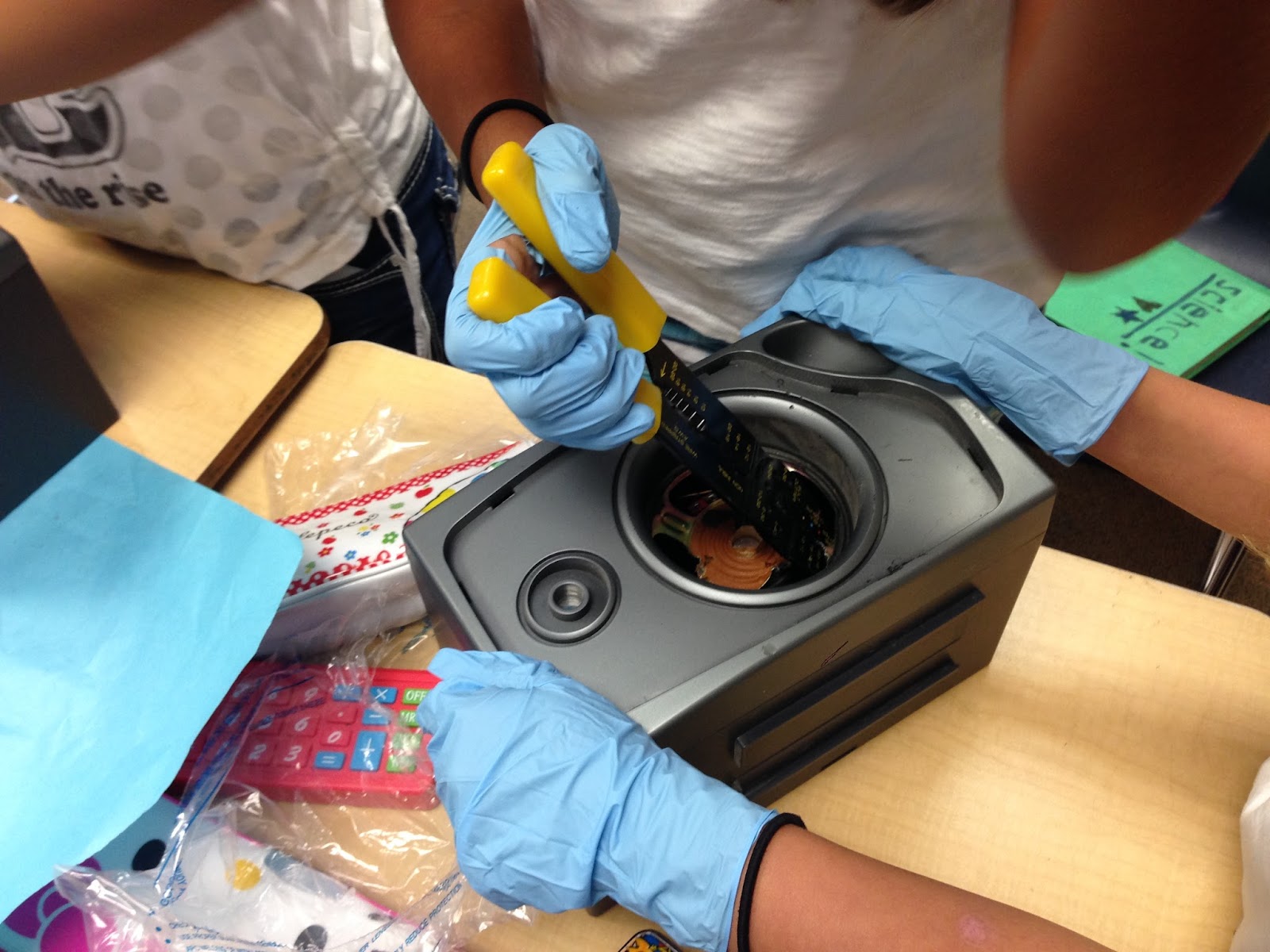
A 1980's cassette player, a broken computer mouse, an old monitor... all ready for the dumpster... drop it by my classroom! Why? For my "Un-Maker Space" inspired by my first journey to the Bay Area Maker Faire two years ago. This Steampunk Mad-Scientists event with its many innovation, creative geniuses and 100,000’s of onlookers descending on the San Mateo, California area with such a wide array of inventions, it would be hard not to be inspired!

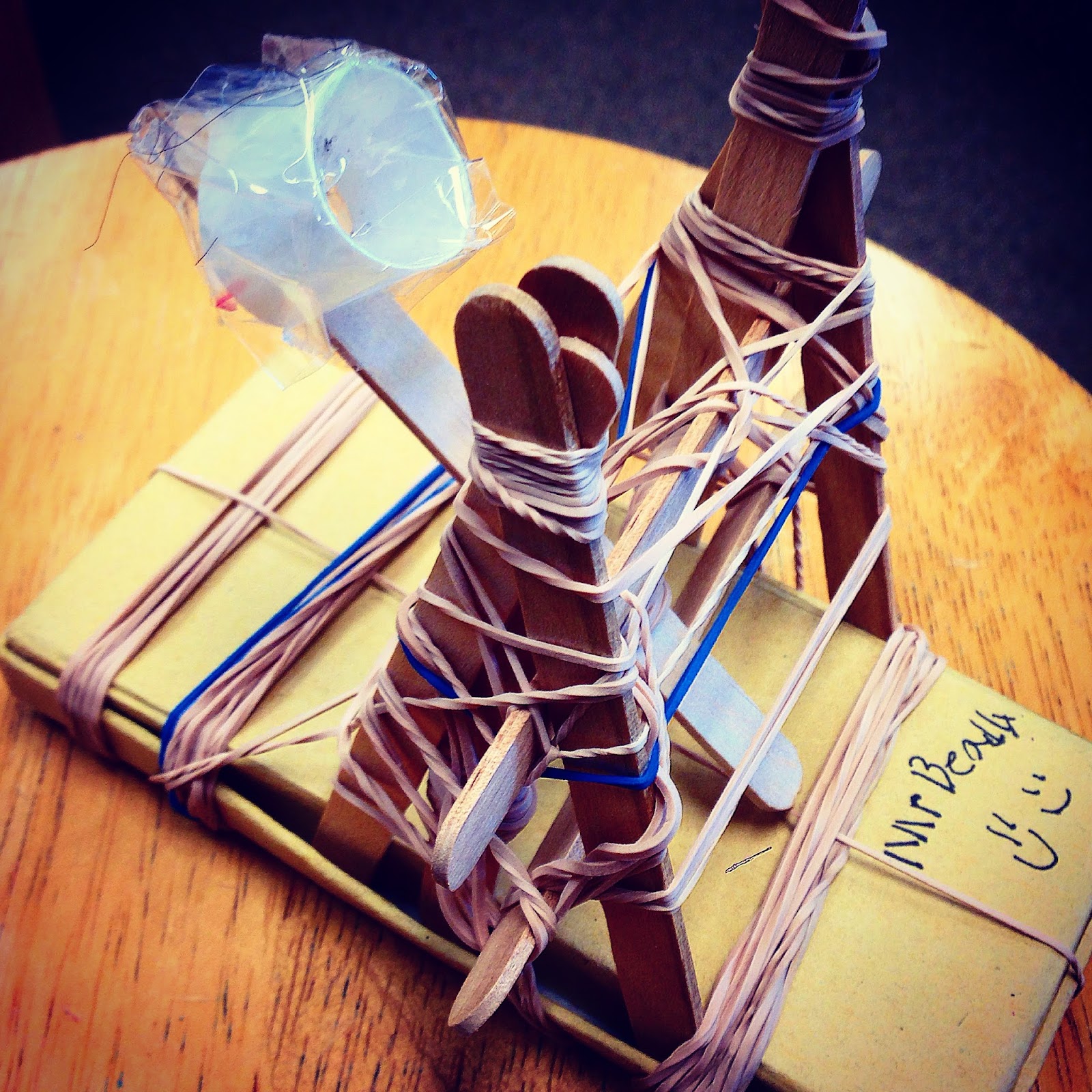
IMG_2510.JPGLet's step back for a moment.  I love all the recent focus on Maker Spaces in schools. If you’re not familiar with what a Maker Space is check out this blog by Vicki Davis. Basically a Maker Space is a place for students to take raw materials and create “things” using their imagination. The creativity required and the "in-time" learning that a maker space provides is powerful. I saw an example of the power of "making" this last school year when I had students, who would normally struggle in a traditional class, create things such as a working catapult fashioned out of popsicle sticks, rubber-bands and cardboard.

IMG_3494.JPG
My journey into exploring the power of making continues for a 3rd year with two added goals. First,I plan to expand the depth of learning that goes with "making" by creating Maker Connection Logs where students write, take photos, and record short videos to show their thinking while making connections between curriculum areas and their creations. The goal of the “Maker Logs” is for students to be able to give me insight into their creative process, thinking and provide a way for reflecting with the hopes of improving the future process of "making."


IMG_3496.JPG
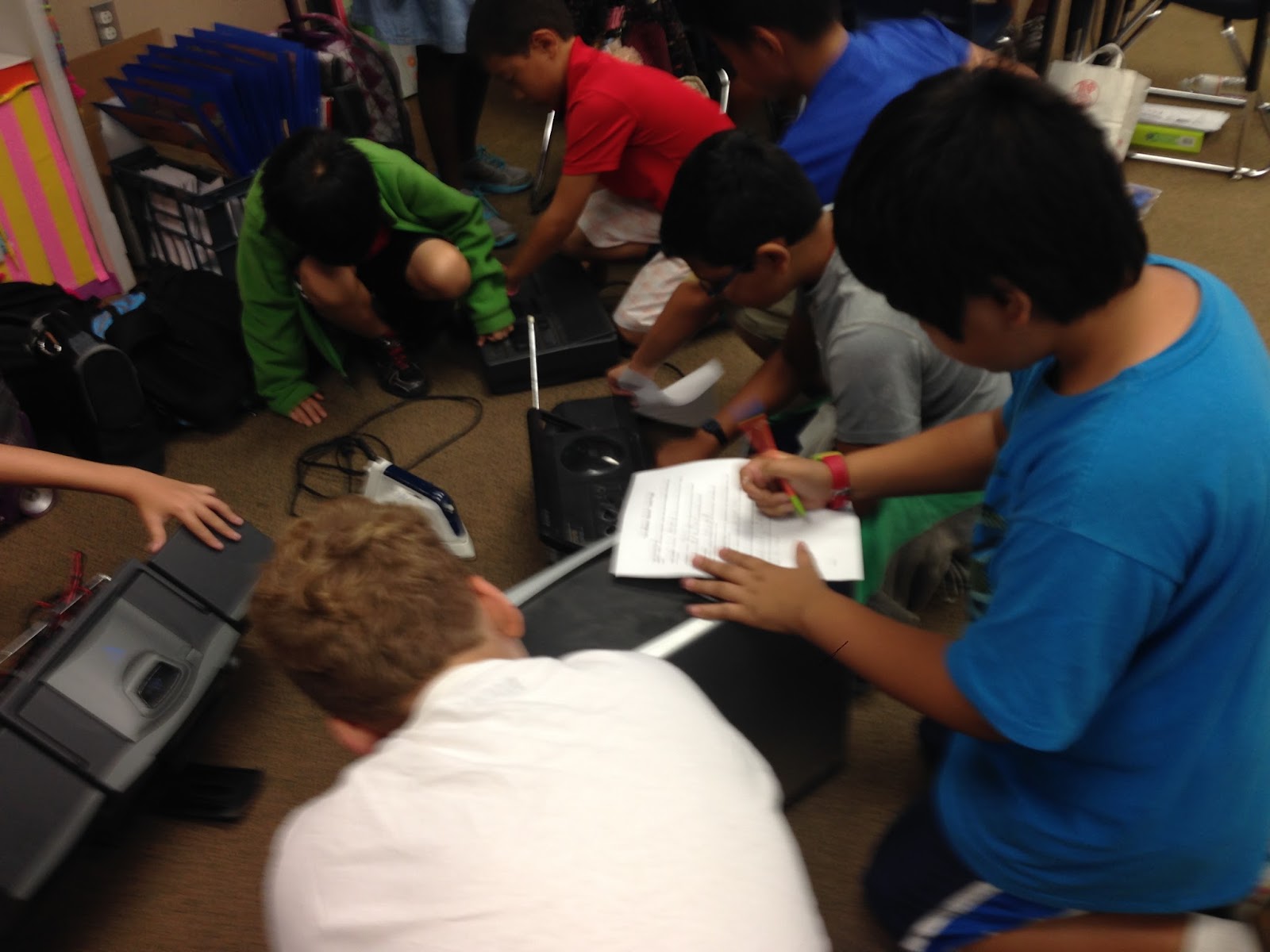
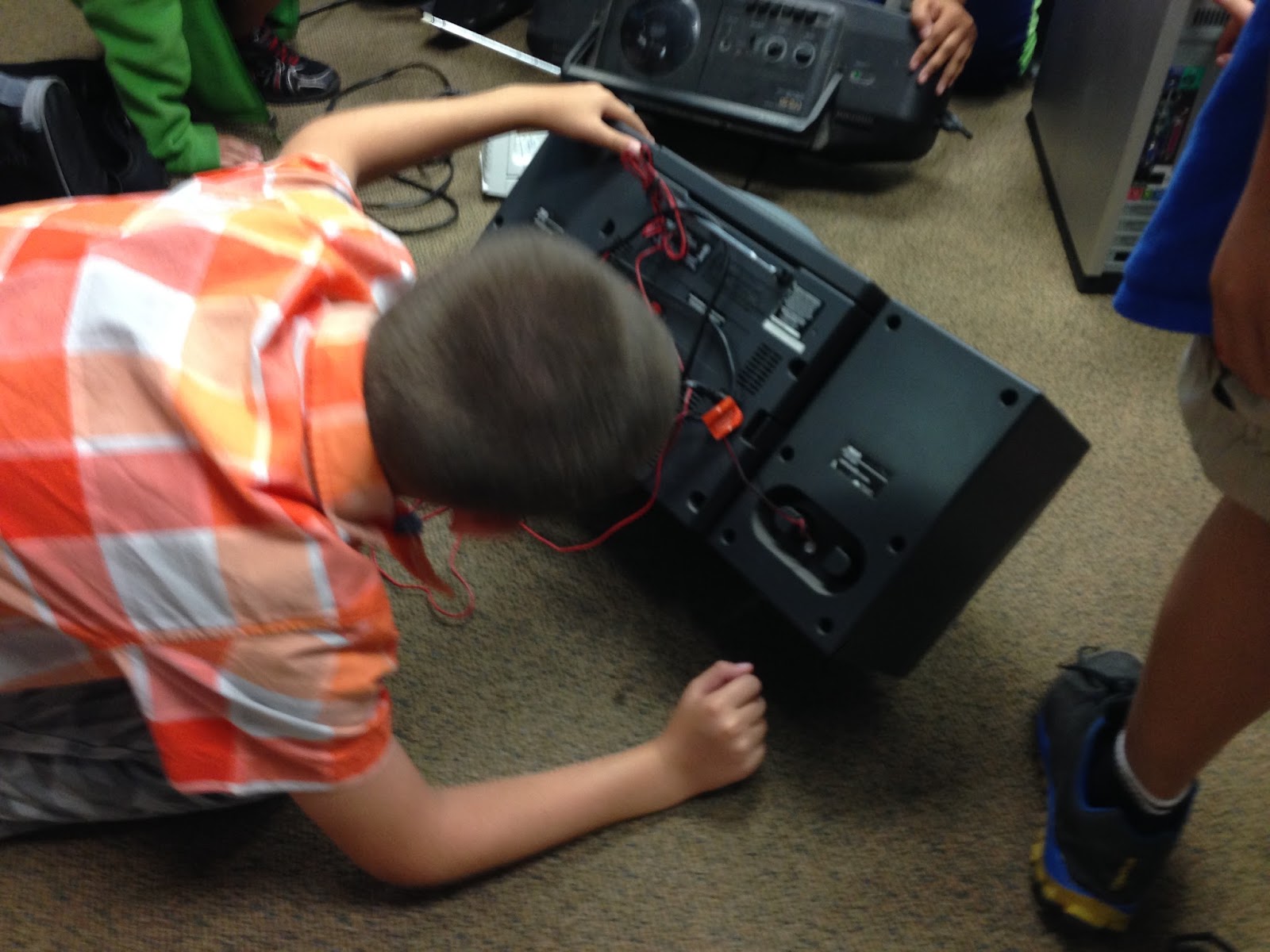
My second goal, which I recently accomplished, is to create an "Un-Maker Space." Simply put, a space where kids can take things apart.  So many of the creative geniuses I met at the Bay Area Maker Faire two years ago spoke of taking things apart when they were kids. Watching my 3 year old son recently take apart his toy vacuum really solidified this idea for me. We all have this inner drive to create an understanding of the world around us. This is founded in the desire to answer all the "why" and "how" questions in our thoughts. Why did that little wheel spin when I pushed the play button on that cassette player? How did the electricity get from the cord into the monitor and then create a picture? How can I take this apart?  So my students will have a space to dissect all the discarded and unwanted items and to ask those questions. In this un-maker space they’ll have the chance to explore the possible answers.


IMG_3557.JPG
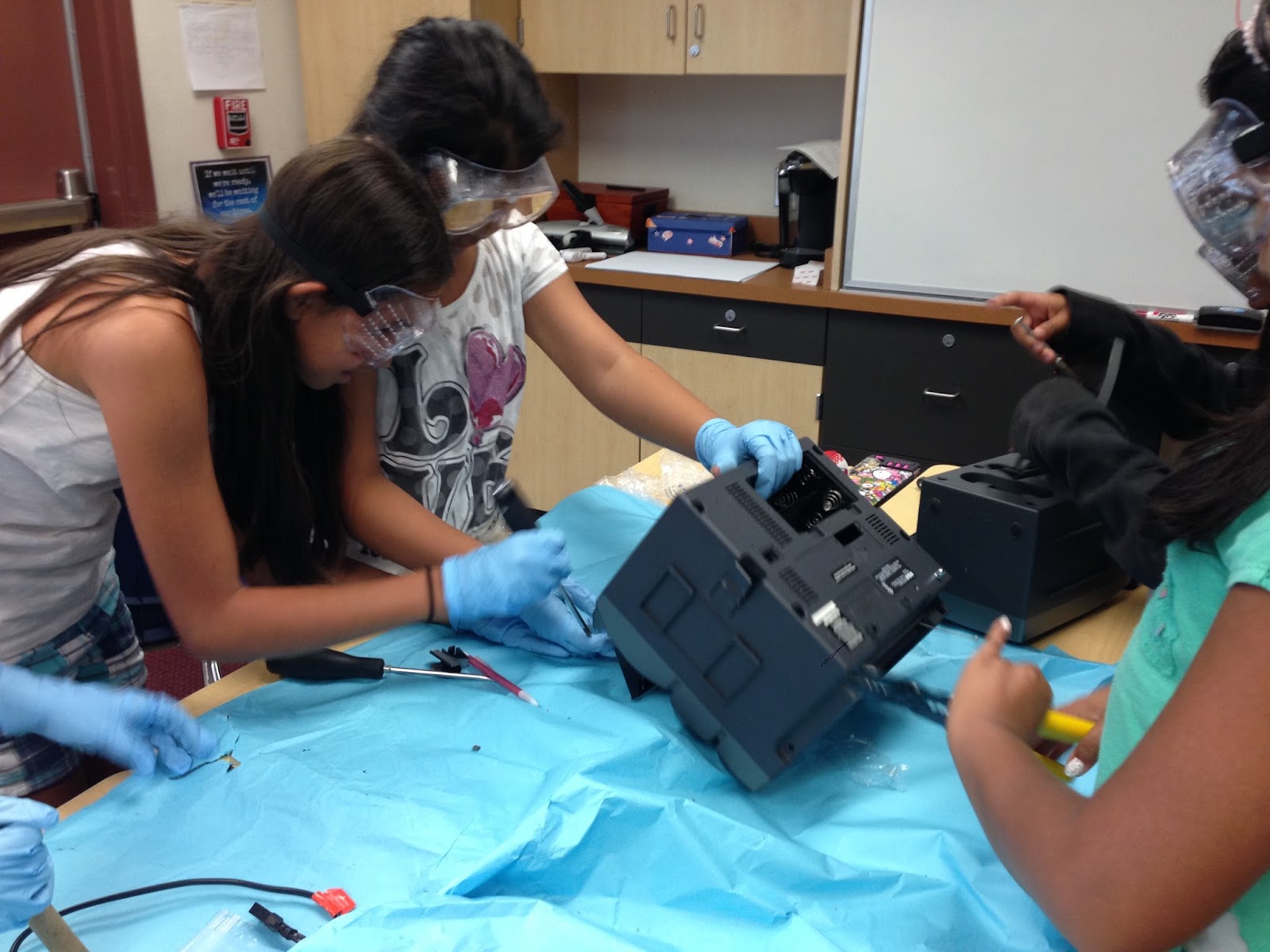
How will I do this? Garage sales! Tool donations, safety gear... And a means for them to log their dissections through writing, photos and video as we explore the scientific way to take things apart.  I see many opportunities for learning including opportunities in math, writing, critical thinking, fine motor skills, and a chance to help develop a greater level of executive functioning skills (to name just a few).  I work hard to foster an atmosphere where student questions drive their desire to learn and this fits right in with it.

Beyond all the learning taking place in the dissection process, it will provide opportunities for students to try and rebuild or use the parts to create something new.


IMG_3576.JPGSo join me and grab those broken cassette tape players before they get tossed into the dumpster. Smile when you see a keyboard that isn't working, and celebrate that old laptop with the broken screen that is out of warranty. It's all how we look at things, our mindset, that can lead us to finding "new" in the old, new questions to answer, new places to explore and new learning to gain. As for those broken "unusables," they get a second life by becoming another learning opportunity for our students! When will you have an UnMaker event in your classroom or at your site?  


I'd love to hear your thoughts. I would also be happy to share the guiding document I created to use with my "Un-Maker" teams.


Monday, July 7, 2014

Assigning Optional Homework?

So... Should homework be required or eliminated?

A few years back, my district went through an exercise of looking at homework and our policies surrounding it.  Meetings were had, discussions and debates occurred, and in the end... nothing much seemed to have changed.  I understand why... this is a tough issue! Homework, after all, is truly a pillar of education.  So as the debate over homework seems to continue on like Pink Floyd's song "Comfortably Numb" ...looped..., some arguing for it and others against it, all with no solution... I'd like to propose an optional new policy... The Optional Homework Policy.  The optional homework policy states this... "Students, if you or your parents would like you to complete homework, then here are your options."  Yes, giving the decision making power, to have or not have homework, over to the students and their families. Crazy!?  Will Not Work!  Kids' Scores Will Drop!  Before you judge, please think growth mindset... and know that I've actually been testing this out over the past school year with positive results for all parties involved with the homework debate.

There are three basic explanations/reasons why I reconsidered required or no homework:

Grades, Grades, Grades...

As teachers we have the choice to calculate homework into a grade or not.  Most teachers I know have homework as a small percentage of a student's overall performance, yet many of the report card conversations between teachers, parents and students, from my experience and as shared with by many other teachers, revolve around the topic of missing or late homework.  Now I don't believe that something should be changed to avoid a conversation, but these conversations can often become distractors or points of contention between parent and student, student and teacher, and teacher and parent, thus creating problems in partnerships that are vital to real learning. These homework conversations are another draw away from the important conversation about learning, true student needs, and areas of growth.

The important question to ask oneself about homework grades is why is it being given?  The typical answer would be work completion, practice of concepts or responsibility at primary levels, and preparation at the higher levels.  Most don't say that the primary or important factor in homework is as a diagnostic tool to report to parents on a students ability or performance. There's too many variables that impact homework to use it as a diagnostic for student learning or as a tool to help guide future lessons and instruction. When homework becomes optional though, the feedback, and not the grade, become more important to the learner.  Feedback is how we learn.  I've seen the focus shift and become about the quality rather than the completion. So rather than giving grades based on completion of work, grades can continue to move towards being about reporting levels of learning growth.

Help or lack of it

It's a "Goldie Locks" deal... some get too much, some not enough and others just the right amount. While parents and teachers are often on one side or the other in this debate, the optional homework policy pleases all. Ideally the parents who may offer too much help to a child, thus taking away their chance to feel the success that builds confidence, find that their help (which is at times aimed at grades) becomes obsolete and the focus shifts to supporting a child's learning.  Fewer conflicts occur between child and parent and student and teacher.  On the other hand, the student that always struggles with homework, and comes to our learning environments already with a feeling of failure, now is far more open to learning.


Real Impact?

On a study my teaching partners and I did in 2007, surrounding homework's true impact, we found that through a comparison based in data, the students who received less homework (in the subject area of math for our study) had three key factors surface.  First, parents reported better relationships with these children. Next, students positive attitudes and feelings towards learning and school showed a measurable increase as well as in-class focus and participation based on surveys and observable evidence by two outside teachers watching the three groups in class for engagement and effort. Finally, the group who received the least amount of homework, actually showed the highest percentage of gains from pre-assessment to post assessment on the math concepts.  Again, with the number of variables, I can't say beyond doubt that homework or lack of it, was the factor that truly made the difference, but it did play a key factor.


Still not convinced... Me either

My main hope is to "get you up on the fence" about this topic so you can look down on both sides and clearly evaluate homework requirement practices and why they are in place.  One quote that sticks with me came from some of the additional video content from the movie Race to Nowhere.

"Homework may be the greatest single extinguisher of children's curiosity that we have yet invented..."

So, where do our fears as educators and in education lie with letting go of homework? Are we giving homework because it's always been done or because it makes a positive impact?  If you believe it makes a positive impact, what real concrete proof do you have that it's the homework providing this improvement?

I write this blog only to encourage you to question things that have always been... I hope you'll question some norms... maybe even check out my previous post titled "Subversive Education Unconference Style"

My Steps and Results

So what did I do to make homework optional? Well... when I change things I don't only consider the implementation I will make, but I consider "will others be able to do this too?"  Confession... This isn't for everyone. Baiscally I took the assignments I would normally assign and said... "This is optional..."  after all, I have no foundational research to show homework was actually beneficial, so how could I justify continuing a required practice that no one could prove even worked after decades and decades of research and debate.  So rather than stop giving it, or continuing to require it... I made it optional leaving the decision to the parents and students.

How has my experiment gone? First, please know I wouldn't have tested this without the data from the study we did in 2007 and a great deal of research... but it's been great!  One of the most positive outcomes I've seen is that it's pushed me as an educator to continue create in-class assignments that drive kids to want to continue their learning on their own at home, intrinsically, by choice. It's so rewarding to have my students have the desire to learn more about a subject I'm teaching, because it's one of the main reasons I went into teaching... to inspire my students to learn.  In addition, many students who have wilted under "required homework" policies have started to blossom and come to life as learners in my subject areas.  I can't say beyond a doubt that The Optional Homework Policy has alone created the success and desire to learn I've seen, as I'm always trying new ways to inspire my students to learn, but I do feel confident it's been a key contributing factor to success for both my students and myself.

I'd love to hear your thoughts on the issue.

Are you going to try The Optional Homework Policy? Tweet at me or comment to let me know.  My next action step... student choice self-assigned homework. I'll let you know how it goes...

Additional reading on the homework debate that's gone on since the early 1900's ACSD's look at Homework through the 20th and 21st Centuries

Thanks so much for reading!  With my best hopes for you and your students!

Subscribe and check out my next blog post on Creating E-Magazines with your students or read my recent post on Live Broadcasting: Creating Your Own Student Press Conferences!

Friday, April 11, 2014

Subversive Education Un-Conference Style!

It takes distance for me to really get a full perspective. I think of the many drives I’ve taken into Yosemite Valley, stopping at Tunnel View or standing at Glacier Point, looking back on the tree filled valley, river winding, rock formations surrounding it like the hand of God holding this amazing location in it’s palm.  It’s that perspective, that can be found in those lookout spots in life.  Likewise while standing at the base of El Capitan and looking up at the largest monolith of granite in the world or being drenched on the Mist Trail by two massive waterfalls towering over in Vernal and Nevada Falls, you can feel so small and in your surroundings.  Surfing gives me this same perspective as I'm sure something in your world gives you. For me, both the near and far have moments that provide perspective.


Breakfast Pre-Edcamp LA
Edcamp LA Photo Walk
Please know, I loved my experience at EdCamp LA, but it does not compare to the inspiration that Yosemite holds for me personally.  Yosemite is simply my way to show a clear distinction of perspective.  EdCamp LA in every way was an awesome experience for me as an educator. This blog post though is my "Tunnel View" or "Glacier Point Perspective" and not my valley experience on EdCamp LA.  

My valley experience would be filled with my conversations with the dedicated educators I spoke with throughout the day starting at breakfast with Sean, Chris, Elizabeth, Senna, Greg and David leading into the jokes and smiles with amazing educators like Bill, JR, Elana, Jo-Ann and others.  It would have the details of how to take Minecraft use in my classroom to the next level, or the meandering photowalk from the depths of the parking garage to the highest point of the four story school building rooftop playground.  Some of those details are now difficult to see as my memory fails me regularly, others are only valuable when emerged in the experience itself.   What remains are those big ideas, those "Half Dome" landmarks that impact my view on the classroom and my instructions.


Looking back two things still standout to me and come to mind regularly...

First: Courage and Connection

Courtyard Connection
During the session I had put on the board titled Subversive Education (I'll tell about that coming up) , backed away from the circle of seats I had adjusted, sat a lone lady. I spoke encouraging words for her and others to join the circle for the session. Most did... she did not. As we got to the heart of the session many of the group were agreeing on one specific topic but not that one unlikely vocal teacher who sat outside the discussion. She got major pushback from the group as a whole but this teacher had the courage to speak against what most in the session were sharing about and brought up some very valid points. I admired that despite the pushback, she still spoke. For me, her subversive perspective on one of the topics in the session was beautiful!   
 

As I ate lunch in the courtyard outside, I saw that same teacher, again off on her own, eating lunch.  I wanted to learn more about her and the courage I felt she demonstrated. I approached her and started up a conversation. I'm an introvert and connect better one on one and feel a bit awkward in large social setting even though I push myself to participate in them (& why I picked the title of an upcoming blog of mine On Being Social Media Awkward). As I did, one of the educators I respect the most, Genein Letford, came out and I invited her into our conversation. As Genein and I learned more about this special education teacher, I could see the courage she had and knew this was how she taught. With courage. As much as I feel Genein and I may have shared with her about things, I was incredibly inspired by her story and courage. Although there is so much more to the story and the conversation, I will leave those details on the "valley floor." Those in the session may remember her for taking a not so popular stance. I'll remember our conversation and that she spoke up with courage and that was truly why I posted the Subversive Education session at EdCamp LA. She was the model of disruption and looking from a distant vantage point the details fade, but the monument of courage and connection stands.

Second: Subversion/Disruption 

I whole heartedly believe in the concept of disruption. I see the value that disruption creates. I see the beauty that comes from subversion. My quick definition of subversive education/disruption is a teacher, a group of educators or an organization going against the norms (norms like pacing guides, standards, and the enforced requirements) all in the effort to create a more powerful learning opportunity for their students. It's not about opposing things, but about providing innovation that leads to deep learning and potentially systemic changes. After all... if all we do is follow the same path set out before us, innovation would not occur. So I taped up (on the outside of the session boxes encouraged by Sean and Vicki) on the EdCamp LA board "Subversive Education: What cool things are you doing that don't fit the standards or Common Core?" Selfishly I wanted to have this session to confirm what I suspected, that I wasn't the only one experimenting with new strategies and pedagogy in this transition time between standards. I wanted to know what other efforts where happening to innovate and positively impact kids lives and educational experience... but happening "somewhat underground." 


The session started with me sharing about a non-education speaker I had listen to a few weeks prior at the 2014 OC Business Outlook (I believe I was the only k-12 teacher among thousands at that event). He had told stories about small start-up companies disrupting the way things worked for the big corporations and how the big corporations could "deal" with these small disruptors. I was so inspired, but I'm not sure it was how the speaker intended. I didn't hear his message from the big business view, I heard it from the view of the disruptor. I figured that if we, as small "classroom start-ups,"could innovate and disrupt, then the education world would have to shift from the same old thing and change just like the shift small start-ups named Google, Apple, YouTube and others did to the world of information and technology.  


To lead the sharing of risks in the Subversive Education session, I told my personal stories of having a class pet that wasn't allowed. No big deal. I was hoping to start small and lead up to a climax of education changing discussions and idea generation. I spoke of trying to podcast with my students several years before and having our district place a sticker on my personal Apple computer that I brought in to use to produce the student "Stories in History" podcasts. The sticker simply said along the lines of "This is Not An Approved Electronic Device and Must be Removed Immediately!" along with some other district rules for power use. I know neither of these I shared were massive disruptions, but both had the intent of providing a positive experience for my students.  


The session was off and running with many of the other amazing teachers sharing stories of subversion, some big and some small. The discussion went in many directions all with the continued hope of sharing about educational lessons that didn't follow the norms or standards, but that these dedicated educators knew were good for their students. It was empowering to know this was happening all over. I hope if you read this, you too will share your story of disruption and subversion with others. I also hope to see Subversive Education sessions cards pop-up (on the outside of session boxes of course) on session boards at other EdCamps! After all... it is the Un-Conference and perfectly disruptive itself!


* I'm thankful for the time I spent at EdCamp LA. It was a valuable investment that has paid off over the last two month in my classroom and my teaching spirit. I'm so thankful to the educators and contributors who took their time to organize such an awesome event. If you haven't attended an EdCamp I hope you'll consider it soon. Most importantly, I hope you'll become a disruptor of the norm, working to innovate the educational experience we provide for our most valuable resource... our kids!


For Info or Support in Starting Your Own Subversive Education Session at Edcamp, Please Contact Me @TASFair or @ScottBedley on The Twitters.


Look for the upcoming blogpost on CUE14 and a disruptive topic Optional Homework... Seriously? Thanks again for reading and pardon any errors and formatting issues!